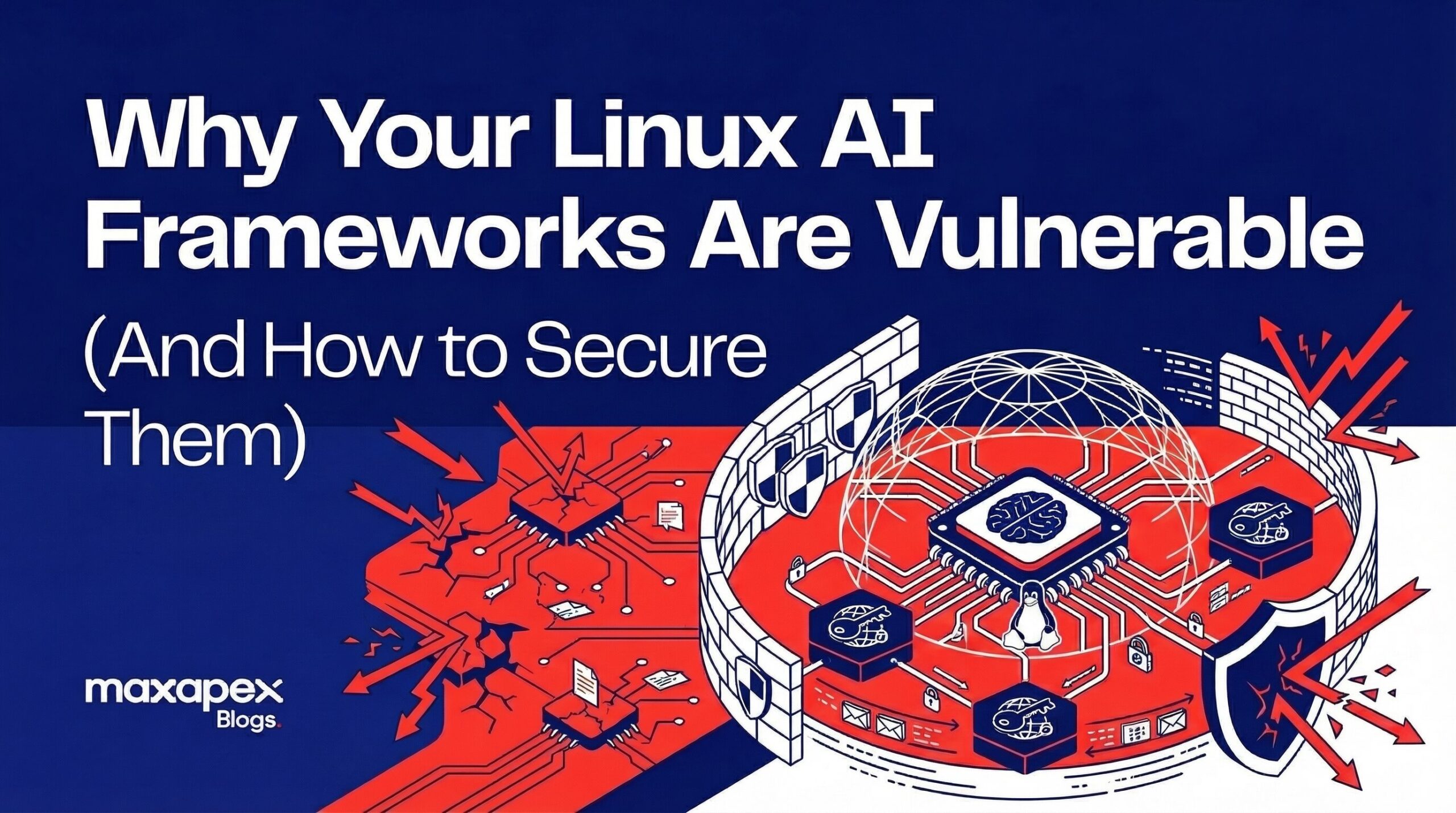


The rush to integrate Generative AI into business operations has created a massive blind spot in Linux server security. To deploy custom AI models and agents quickly, development teams are spinning up powerful open-source frameworks like Langflow and vLLM on their Linux environments.
The problem? These tools were built for speed and innovation, not out-of-the-box enterprise security.
At MaxAPEX, our SOC team has watched a sharp rise in automated attacks specifically targeting exposed AI endpoints. If you are running AI workloads on Linux without a hardened perimeter, you aren’t just risking your data—you are handing over expensive GPU compute power to cybercriminals.
Here is why AI framework vulnerabilities are the new frontier for hackers, and how you can lock down your infrastructure before it’s too late.
The Danger of “Default” AI Deployments
Frameworks like Langflow (a visual UI for LangChain) and vLLM (a high-throughput LLM serving engine) are incredibly powerful. However, they are frequently deployed with their default configurations, which often lack basic authentication.
When these frameworks are directly exposed to the public internet without a secure Linux API gateway, they become low-hanging fruit for automated scanners searching for open ports.
1. The Langflow Exploit: A Direct Path to RCE
Langflow allows developers to build complex AI agents by dragging and dropping components. Unfortunately, recent vulnerabilities have shown that if an attacker can access the Langflow UI or API, they can achieve Remote Code Execution (RCE).
- The Threat: By injecting malicious code into the workflow components, a hacker can execute arbitrary commands directly on the underlying Linux host.
- The Result: Complete server takeover. They can deploy ransomware, pivot to other servers on your network, or exfiltrate sensitive proprietary data feeding your AI models.
2. vLLM Security: Hijacking Your Compute Power
vLLM is designed to serve massive AI models efficiently. If the API endpoint is left open, attackers don’t even need an exploit—they just use your exposed API as their own personal AI engine.
- The Threat: Attackers flood your vLLM endpoint with high-volume, complex prompts.
- The Result: Your server’s GPU and CPU resources are entirely drained, crashing your legitimate applications. Worse, attackers can use your infrastructure to generate malicious content, launch prompt injection attacks, or orchestrate crypto-mining scripts.
How to Secure Your AI Frameworks on Linux
Patching the frameworks isn’t enough; you need structural security. If you are deploying Langflow, vLLM, or any similar tool, you must implement these baseline defenses immediately:
Step 1: Never Expose the Native Port
Never let vLLM or Langflow bind directly to public IP addresses (e.g., 0.0.0.0:8000). Bind them to localhost (127.0.0.1) and use a secure Linux API gateway (like Nginx or HAProxy) as a reverse proxy to handle incoming internet traffic.
Step 2: Implement Strict Authentication
Do not rely on the framework’s experimental or basic authentication. Enforce robust API key management, OAuth2, or mutual TLS (mTLS) at the API gateway level before a request ever reaches the AI engine.
Step 3: Monitor API Behavior (Not Just Signatures)
Because AI API requests look like normal text data, traditional firewalls often miss malicious prompt injections or RCE attempts. You need behavioral monitoring to detect when an AI framework starts executing unusual Linux commands (like spawning a bash shell from a Python worker).
Advanced AI Security Without the Enterprise Price Tag
Securing advanced AI workloads requires continuous monitoring of both your network traffic and your Linux system’s internal behavior. For most mid-sized businesses, building an internal team to monitor these complex attack vectors is simply too expensive.
This is where MaxProtect changes the math.
Instead of leaving your expensive AI infrastructure exposed, MaxProtect provides an enterprise-grade security overlay starting at just $100/month.

How MaxProtect Secures Your AI Servers:
- Process Anomaly Detection: If an exposed AI framework attempts an unauthorized “Living off the Land” command on your Linux server, our EPP detects and stops it instantly.
- 24/7 Monitoring: Our monitoring operates 24/7, providing constant, round-the-clock vigilance. If an anomaly is detected in the middle of the night, our system is already responding and mitigating the threat before you even wake up.
Is Your AI Infrastructure an Open Door?
Don’t wait for a compromised server to realize your AI frameworks were exposed. Get a clear, technical view of your current vulnerabilities.